
March 26, 2026
Why Late Goals Change Everything: The Hidden Psychology of Live Football Betting
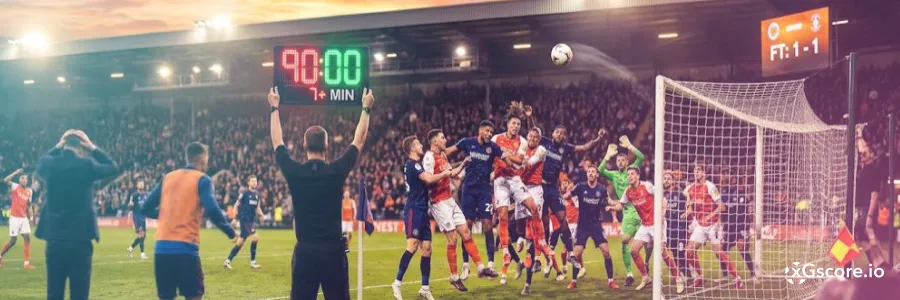
The fourth official holds up the board. Seven minutes of stoppage time. The away team, trailing by a goal, wins a corner. Their goalkeeper sprints forward and jumps into the penalty area. Every player is packed into the box. The cross comes in. Chaos erupts. And somewhere, in the background, betting odds begin shifting so fast that by the time the ball hits the net — or doesn't — the markets have already changed three times.
There is something about the final minutes of a football match that feels different from any other sport. Basketball games have tense finishes. Hockey overtime brings sudden death. But football's clock runs one way. When it hits ninety, the end is near. Those last moments carry weight that the first eighty-five minutes simply do not.
Why the Final Minutes of Football Are So Predictably Unpredictable
Late goals happen for reasons that start building around the seventieth minute. Players tire. Defenders lose concentration. Teams trailing by a goal stop playing cautiously because caution no longer helps.
Consider a match scenario which is quite popular among players who enjoy betting in kenya. A team is down 1-0 with fifteen minutes left. The manager throws on an extra striker. Full-backs push higher. The midfield stops tracking back. Everyone knows the next ten minutes will determine the result. This tactical desperation creates space, mistakes, and chances.
Fatigue matters just as much. A centre-back who tracked a striker for eighty-five minutes now moves half a step slower. That half step is enough. A cross that would have been cleared in the first half falls to an attacker. The ball ends up in the net. What looked like a settled match becomes something else entirely.
Stoppage time adds another layer. The clock doesn't stop in football. Those extra minutes, awarded for substitutions and injuries, become a compressed period of chaos. Teams with momentum keep pushing. Teams protecting a lead defend deeper. The ball spends more time in the penalty area. Something usually gives.
How Live Betting Markets React When a Late Goal Arrives
Live odds exist in a constant state of adjustment. Every pass, shot, and corner influences the numbers. But nothing moves markets like a goal in the final minutes.
Picture a match where the home team leads 1-0 in the eighty-eighth minute. The away team wins a free kick on the edge of the box. Before the kick is taken, the odds of an equaliser shorten slightly. The ball goes into the wall. Nothing happens. Then, from the rebound, an attacker volleys it toward the goal. It deflects off a defender and loops into the net.
In the seconds between the shot and the goal, live betting markets freeze and recalculate. When the goal stands, the odds on a home win vanish. Draw odds crash. The over 2.5 goals market, which looked dead at 1-0, suddenly pays out. Anyone watching the match and following the live odds experienced all those shifts in real time. The goal changed everything.
A stoppage-time winner does something similar but more dramatic. Imagine the score is 2-2 in the ninety-second minute. A corner comes in. A defender heads it clear, but only as far as an attacking midfielder on the edge of the box. He strikes it first time. The ball flies through a crowd and into the corner. The match ends moments later.
Bettors who backed over 3.5 goals watched their bet win in the final touch of the game. Those who bet on the draw watched it slip away. The same moment created opposite outcomes for different people.
The Emotional Side of Betting During Stoppage Time
Something happens to decision-making in the final minutes. The combination of tension and limited time creates a feeling that decisions must be made immediately.
A bettor watching a match notices one team applying relentless pressure. Wave after wave of attacks. Corners stacking up. Shots blocked, cleared, or saved. The usual rhythm of the game has disappeared. It's now just attack, defend, repeat. The feeling grows that a goal is coming.
This is where the emotional pull intensifies.
Placing a bet with two minutes remaining feels different from placing one at halftime. There is no time to second-guess. The next attack might be the last. The odds on another goal shorten with every corner. Bettors either act at that moment or the opportunity passes.
Mobile apps make this experience immediate. The same device showing the live stream also displays shifting odds. Bettors watch the ball travel toward the penalty area while numbers change on the same screen. The two things become connected. Watching and betting merge into a single activity.
Reading the Signs of a Possible Late Goal
Not every late goal comes out of nowhere. There are patterns that experienced observers notice.
A team chasing a goal in the final minutes often shows clear signals. Full-backs stop bothering to track back. The goalkeeper starts looking for quick throws rather than wasting time. Substitutes bring fresh energy against tired defenders. Corners and throw-ins deep in opposition territory become more frequent.
Imagine a match where the away team has dominated the last ten minutes. Four corners in a row. Two shots blocked. The home defence looks disorganised, clearing the ball anywhere rather than to teammates. Each clearance comes straight back. The crowd noise grows. These events are signs that pressure is building toward something.
Bettors who notice these patterns sometimes act before the goal arrives. They might place a bet on another goal before the odds shorten further. They might back the team applying pressure to score. Or they might simply watch more closely, knowing that something is likely to happen.
The opposite signals exist too. A team protecting a lead might waste time deliberately. Slow goal kicks. Long walks to take throw-ins. Substitutions that eat up thirty seconds each. When these tactics dominate the final minutes, the chances of a late goal drop. The team leading has successfully killed the game's momentum.
Why Live Betting Makes Late Goals Even More Dramatic
Football without betting still produces dramatic late goals. Fans celebrate. Players collapse in exhaustion. The narrative of the match flips instantly. But live betting adds another layer to that drama.
Every late goal now carries multiple meanings. It changes the result. It shifts league tables. And for those watching with active bets, it determines whether a selection wins or loses in real time. The same moment that brings joy to one set of fans brings disappointment to another.
The combination of football's unique clock and live betting technology creates something that did not exist a generation ago. Bettors experience the final minutes differently now. They watch for attacking pressure not just as fans but as people whose decisions hang on the next touch of the ball.
When that ninetieth-minute cross loops toward the far post, everyone watching knows what is at stake. The defender jumps. The attacker jumps. The ball hangs in the air for what feels like minutes. Then it drops. And the odds change again.

- Premium xGscore predictions
- Profitability ROI 5% and higher
- 19 Premium tips This Week