
April 10, 2026
Red Cards vs. AI: How Live Predictive Models Adapt in 2026

Artificial intelligence transformed sports betting from a game of intuition into a battle of processing power. In 2026, live models don't just track the ball; they simulate thousands of parallel realities every second. When a referee reaches for his back pocket, these digital brains face their ultimate stress test.
The Mathematical Chaos of a Ten-Man Pitch
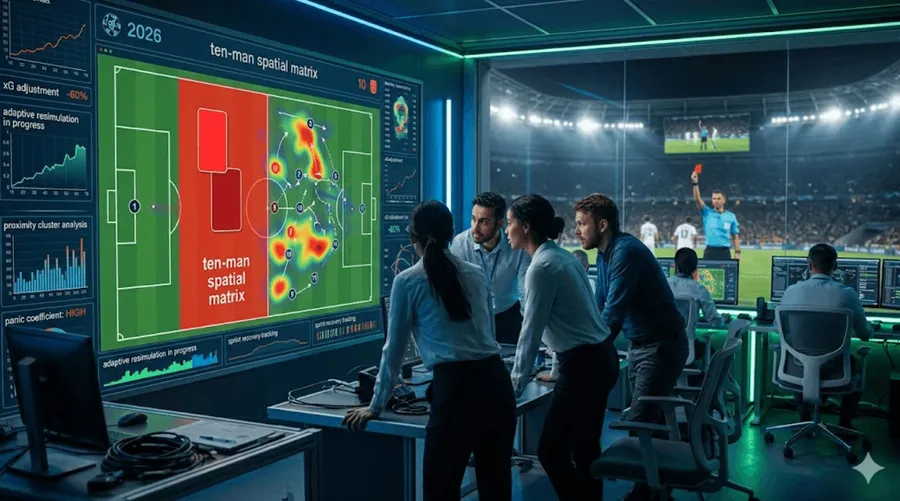
A single red card destroys the pre-match tactical blueprint instantly. Suddenly, the expected goals (xG) metric for the penalized team doesn't just dip; it craters by roughly 60 percent according to recent data from top-tier European leagues. This shift forces live algorithms to recalculate every defensive movement and player fatigue level within milliseconds. Analysts looking for an edge often explore the Afropari affiliate network to see how modern platforms handle such volatility in real-time. Systems now prioritize spatial occupancy over traditional possession stats because ten men must cover the same 7,000 square meters of grass.
Modern AI treats a dismissal as a "phase shift" rather than a simple numerical disadvantage. The software looks for specific behaviors to determine if a team will collapse or find a second wind.
- Low-block efficiency: Models track if the defensive line drops by more than 5.4 meters on average within two minutes of the card.
- Sprint recovery times: Digital eyes track if midfielders are blowing gaskets trying to cover the missing man's zone.
- Counter-attack probability: Models now weigh a lone striker's speed more heavily than the entire team's passing accuracy.
Does a computer feel the tension of a stadium? Not really, but it reads the biometric output of the players. If three players show significant heart rate spikes and a drop in running distance simultaneously, the AI knows a goal is coming.
Beyond the Numbers: Predicting the Manager's Panic
Predicting how a human coach reacts to a red card used to be the "secret sauce" for veteran bettors. By 2026, AI has decoded these patterns by training on thousands of hours of historical tactical shifts. It knows that some managers instinctively park the bus, while others make "suicidal" attacking substitutions. These models assign a "panic coefficient" to certain coaching styles based on their historical tendency to leave gaps during transitions. A high coefficient means the team is likely to concede again within ten minutes of the first card.
Surprising data from this season shows that home teams receiving a red card actually perform 12 percent better than away teams in the same situation. The "twelfth man" isn't a myth to the machine; it is a measurable boost in defensive intensity.
- Tactical Over-correction: Machines often predict when a coach will remove their best creative player for a sluggish defender, leading to a 22 percent increase in sustained pressure.
- The "Angry" Response: Certain teams increase their foul rate by 40 percent after a dismissal, leading to a high probability of a second red.
- Goalkeeper Heroics: Models now track "save-above-expected" (PSxG+/-) streaks, identifying when a keeper enters a flow state under siege.
Computers have finally realized that football isn't played on a spreadsheet. They can now spot a tired left-back losing his temper three minutes before he actually commits the foul. That is a terrifying level of foresight. It makes you wonder if the "beautiful game" is becoming a solved equation. Even with a man down, the machine usually knows exactly how the story ends.

- Premium xGscore predictions
- Profitability ROI 5% and higher
- 1 Premium tips This Week